


Hasselblad 500 EL
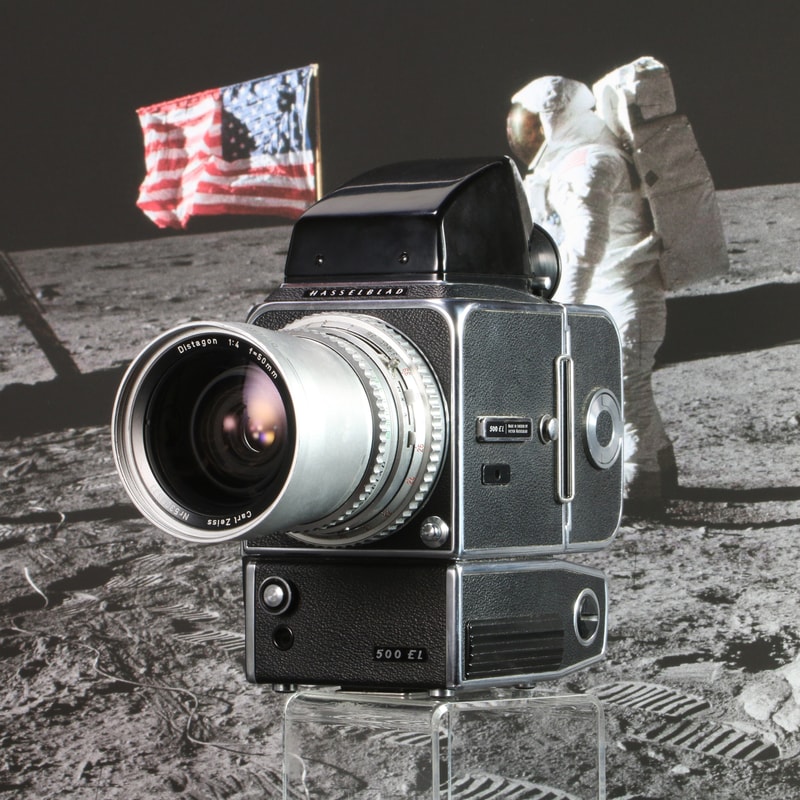
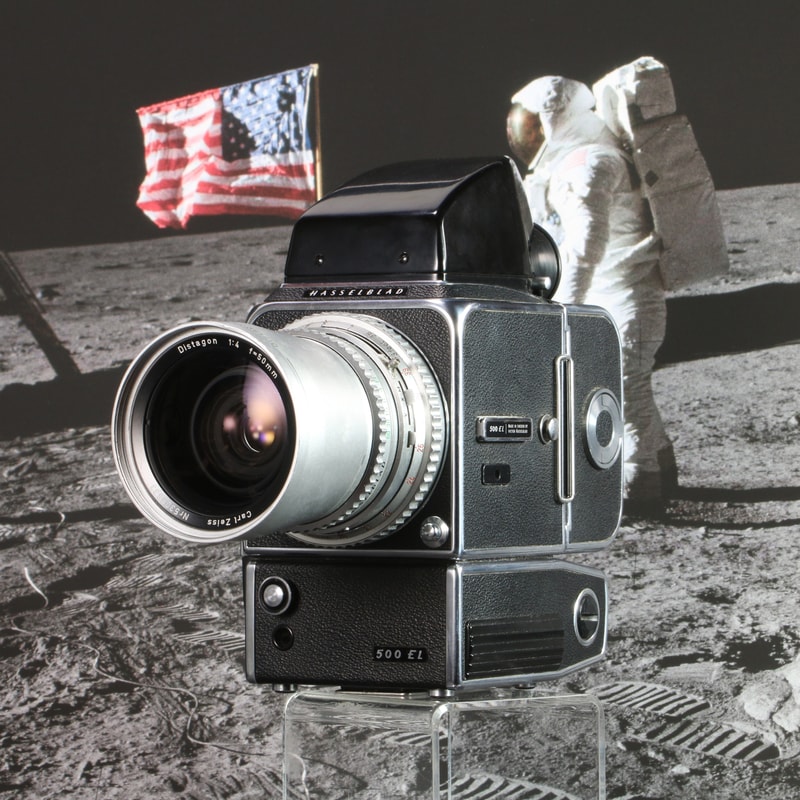
The Hasselblad 500EL is a motorized 6x6 medium format SLR camera that debuted in 1965. Designed as a fully integrated electronic version of the legendary 500C, it became famous for its use by NASA during the Apollo 11 mission to photograph the moon.
Unlike the manual 500C, the 500EL features a permanent motor drive baseplate that automatically advances the film and cocks the shutter. Like the 500C, the 500EL remains a modular system with interchangeable film backs, lenses and finders (though focusing screens were not interchangeable, like the original 500C). The 500EL offered a few new shooting modes:
- O: Normal setting. Film is advanced after exposure, shutter is cocked and mirror is returned to ready position.
- S: Speed setting. Reduces reaction time of camera between shutter button press and exposure by pre-releasing mirror, opening auxiliary shutter and stopping aperture down to selected setting.
- SR: Speed Repeat setting. Same as speed setting but camera remains in Speed setting after exposure.
- A: Automatic setting. Camera continues to fire at about 1fps if shutter remains pressed.
- AS: Automatic Speed setting. Same as the Automatic setting but camera returns to Speed setting when shutter button is released.
The motorized functionality requires the 500EL to depend upon large, rechargeable NiCad batteries or external power adapters - the latter being the preferred power source in studio settings. Most original NiCad batteries have died due to age and are no longer manufactured but adapters that allow the 500EL to be powered by a common 9v battery are relatively easily found and purchased.
Of course, no discussion of the 500EL is complete without mentioning NASA. Victor Hasselblad had the original idea for the 500EL for use in birding where being able to electronically release a camera from a distance and have it automatically advance and reset would be a big benefit in photographing that skittish subject matter. However the concept was met with skepticism until NASA adopted the camera for use in the Apollo missions, including Apollo 11 which saw the 500EL used on the lunar surface. In this environment the 500EL's automatic functions were a huge benefit for the limited dexterity offered the space suits worn by the astronauts. The camera was used with 70mm bulk film backs that provided dozens of exposures rather than the standard 12 shots. After gaining fame with NASA the 500EL and later motorized versions like the EL/M went on to be popular in portrait and still life studios where the photographer could control the action from their spot of choice while triggering exposures away from the camera.
The 500EL had a production run lasting until 1970 when it was succeeded by the 500EL/M.
Blue Moon Camera and Machine llc
- sales@bluemooncamera.com
- (503) 978-0333
- (503) 978-0370
-
8417 North Lombard Street
Portland, OR 97203
All rights reserved ©2026, Blue Moon Camera and Machine llc
v. 10.05 | 2026-10-06 17:24:55
Oops! Our website needs to cool down for a minute.
In the meantime, some features and components may not load or work correctly. Please try again in a few moments.